
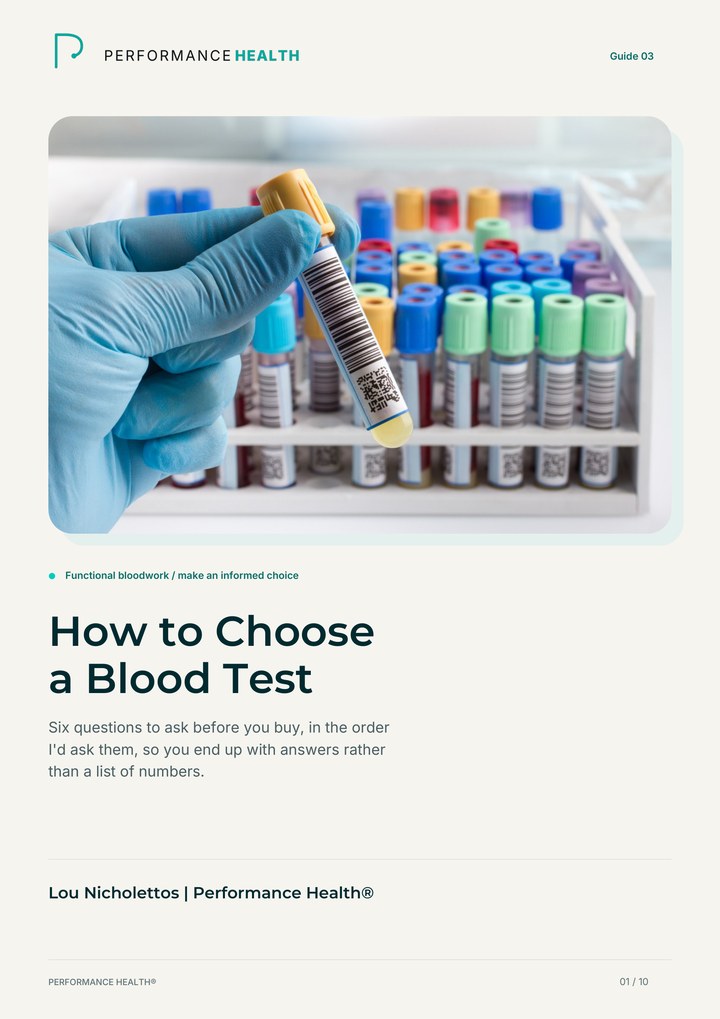
How to choose a blood test: six questions to ask before you buy
Every blood test is sold on two numbers: how many markers you get, and what it costs. Neither tells you whether you'll end up with answers. Six questions do, and the order matters.
- Which markers matter, and which just pad the list
- Finger-prick or venous, and when each is right
- The same result, two verdicts: standard range and optimal range
- What to ask before you pay, so the report tells you what to do first
It's on its way
Check your inbox in the next couple of minutes (and your junk folder, just in case). Or open it now:
Open the guideStart with question one. It decides what the other five mean.
Inside the guide
The six questions, in the order I'd ask them
What do I want to know?
Two very different questions get asked of blood. The first one decides what the others mean.
Which markers, not how many?
Why some markers on the big panels tell you nothing, and the set that describes your main body systems.
How is the blood taken?
Finger-prick or venous, and why it decides whether the markers can be run properly at all.
What ranges are used?
The same ferritin result, "normal" on one report and low on another. Shown on the page.
Read together, and in my context?
Why one marker on its own tells you very little, and what Synergy Patterns® analysis does instead.
What can I do with it?
The question that matters most: information you can act on, and who you'll talk it through with.

Who wrote it
If we haven't met, I'm Lou
I'm a Functional Medicine Physio. I help active people over 40 work out why they feel older than they should, and get themselves back.
I've spent 21 years with the complicated cases, and I've read a lot of blood results that people paid good money for. The ones that left them none the wiser had plenty of markers. What they didn't have was anyone reading those markers for that person, or telling them what to do first. This guide is the six questions I'd ask before I paid for a test.
The guide
Six questions, before you spend a penny
Free. 10 pages. Read it in ten minutes.
This guide is educational and is not medical advice. It does not diagnose, treat, cure or prevent any condition. Always discuss test results and any health concerns with a qualified healthcare professional.